If the GS Stumbles, Does BMW Motorrad Stumble With It?
BMW Motorrad is more successful than it has ever been – and that is exactly why it is worth looking beneath the polished surface. More than 200,000 motorcycles a year, a premium image, option sheets packed with expensive extras, and the R 1300 GS, a motorcycle that has long since become more than just a bike. It is a status symbol, the heart of the brand, and a money-printing machine all at once. But that is precisely where the risk lies: What is left of BMW Motorrad if the big boxer GS ever stops overshadowing everything else?
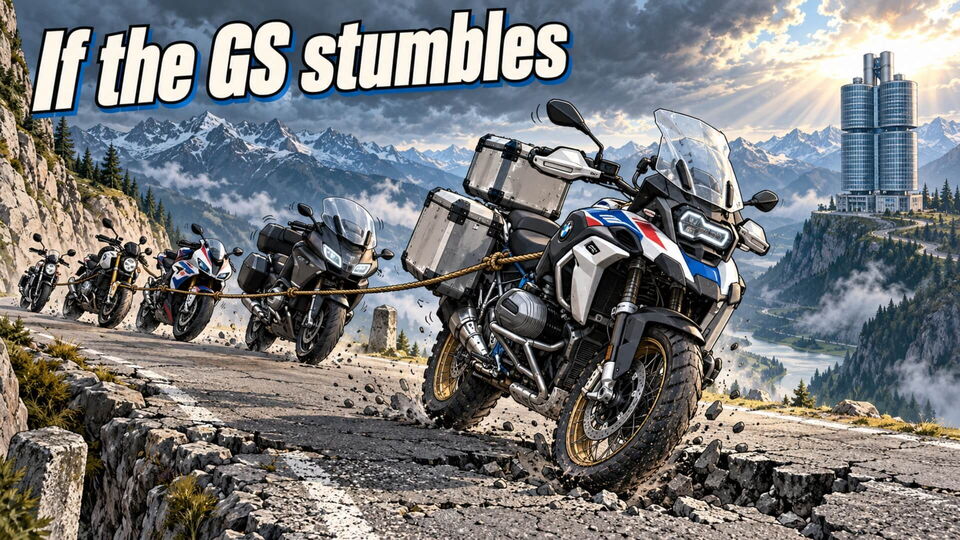
Success Can Make You Comfortable
BMW Motorrad currently has the kind of problem other manufacturers would love to have: The company is successful. In 2025 it sold 202,563 motorcycles worldwide, topping 200,000 units for the fourth consecutive year. BMW is a powerhouse in the premium segment. So this is not a crisis.
And yet it is worth taking a closer look. Success can make a brand stronger – or comfortable. BMW Motorrad has put plenty of fat on its ribs in recent years: big motorcycles, high prices, lavish equipment, substantial margins, and customers willing to spend astonishing amounts of money for the blue-and-white roundel. That works beautifully as long as the most important muscle keeps working. And that muscle is called GS.
The GS Is a Motorcycle, a Status Symbol, and a Business Model
The R 1300 GS and R 1300 GS Adventure together accounted for more than 66,000 sales in 2025. In other words, roughly one out of every three BMW motorcycles sold worldwide was one of those two models. Add the rest of the boxer range and it becomes even clearer just how heavily the company depends on that engine concept and the customer base BMW has spent decades building.
The big GS has long since become more than an adventure bike. It is a technological flagship, a carrier of brand identity, and a justification for premium pricing. For part of its customer base, it is also a status symbol. The successful business owner, senior executive, or well-off retiree doesn't simply buy a motorcycle. He buys the GS, often with packages, luggage, navigation, comfort equipment, and a final price that not so long ago would have bought a small car.
There is nothing wrong with that. Quite the opposite: If you can build a desirable premium product, you should make money from it. It only becomes dangerous when one strong pillar starts to look like almost the entire building.
BMW Needs More Than the Passat
Volkswagen could never survive by selling nothing but the Passat. A volume manufacturer needs the Golf and Polo just as much as it needs the larger sedan. Translated into BMW Motorrad terms, the R 1300 GS can wear the crown. But underneath it, BMW needs motorcycles that bring young riders into the brand, retain riders as they move up, and perhaps turn a 25-year-old BMW customer into a 55-year-old GS buyer someday.
This is where BMW's lineup looks less dominant than the overall sales figures suggest. BMW reported a respectable 41,166 middleweight sales in 2025, actually up from the year before. So models such as the F 800 GS, F 900 R, and F 900 GS are hardly failures. But this range generates neither the desirability of the boxer models nor the halo effect of the S and M machines. It sells, but it does not define BMW.
That is a subtle but important distinction. A healthy model range needs more than motorcycles that generate unit sales. It needs entry-level motorcycles people actually dream about.
The Small GS Was Never Really Welcomed Into the Family
The G 310 GS made that especially obvious. On paper, it could have been the perfect gateway into the GS world: light, affordable, approachable, and wearing a name on its tank that has promised adventure for decades. It was built with TVS in India, which does not have to be a technical problem at all. Other premium manufacturers have long since embraced global production.
The bigger issue was how halfheartedly BMW itself seemed to invest the motorcycle with emotion. The 310 often felt like the bike that appeared in the brochure but was never quite invited to the family reunion. A company that markets the big GS as a globe-trotting icon could have turned the little GS into an irresistible gateway drug: wire-spoke wheels, rugged accessories, rally styling, a proper skid plate, and a clear promise to younger riders. Instead, for many people it remained the little Indian-built BMW you bought because the big GS was too expensive, too heavy, or still out of reach because of licensing restrictions.
And BMW's own 2024 numbers showed that the segment was hardly irrelevant: The G 310 GS, G 310 R, and G 310 RR combined for 22,339 units. That is not pocket change. Which makes it all the more surprising that BMW never built a truly compelling youth ecosystem around them.
The F 450 GS May Matter More Than the Next 1300
That is exactly why the new F 450 GS may be strategically more important than another horsepower increase for the big boxer. BMW needs a motorcycle that does not feel like a cut-price version of a real BMW, but like a real BMW in a smaller package.
That sounds obvious, but it is crucial. A 25-year-old does not buy an entry-level bike because he enjoys being treated like a second-class customer. He buys one because it fits his license, his bank account, and his life. If he feels that he is already part of the same world as the rider on an R 1300 GS Adventure, BMW wins. If he gets the impression that the brand only really begins at $20,000-plus, his next motorcycle may come from Yamaha, Honda, KTM, Triumph, or a Chinese manufacturer.
The small GS therefore has to be more than an inexpensive volume model. It has to recruit the next generation.
The Sportbike Side Works – But It Doesn't Hold Up the House
The picture is considerably better with BMW's sporting four-cylinder models. With the S 1000 RR, S 1000 R, S 1000 XR, and the M bikes, BMW has built a credible second identity. The S 1000 RR was actually the third-best-selling individual model in BMW's entire lineup in 2025, with 11,643 units. The complete S range accounted for 20,859 motorcycles, and together with the M models BMW sold 28,408 four-cylinder machines.
That is impressive and puts to rest the idea that BMW Motorrad consists exclusively of boxer riders in modular helmets. Even so, the question of breadth remains. The superbikes and power nakeds create image, while the XR combines performance with everyday usability and touring ability. But they appeal to another premium customer who is hardly shopping at the bargain end of the market. They do not create a truly broad foundation beneath the big GS.
R 18: Technically Fascinating, Strategically Questionable
At the other end of the lineup sits the R 18 family. Few BMW motorcycles demonstrate more clearly what happens when a manufacturer insists on entering a segment that culturally already belongs to somebody else. The 1,802cc boxer is an impressive piece of engineering, the finish is high-end, and the visual presence is monumental. None of that answers the basic question of who actually needs it.
In Europe, an R 18 is enormous, heavy, and expensive. In the United States, where those dimensions make more cultural sense, it has to compete with Harley-Davidson and Indian. And there the customer is not merely buying steel, displacement, and chrome. He is buying American identity. A German interpretation of the American cruiser can be objectively excellent and still miss the emotional point.
The R 18 is therefore not a bad motorcycle. It may be something more dangerous: a very good motorcycle for a limited market that consumed an enormous amount of engineering, product-development, and marketing energy.
The Big BMW Scooter Has Disappeared
The scooter side looks similarly odd. BMW once had serious maxi-scooters in the C 600 Sport and C 650 GT, genuine alternatives to machines such as the Yamaha TMAX and Suzuki Burgman. That class has disappeared from BMW's lineup. What remains are the C 400 X and C 400 GT, plus the electric CE 02 and CE 04.
The numbers here are not disastrous either: BMW's Urban Mobility segment topped 18,400 units in 2025. But the competitive landscape is changing brutally fast. Chinese manufacturers in particular are launching 400cc and larger scooters with generous standard equipment at prices that make BMW's premium positioning increasingly difficult to explain. TFT displays, keyless ignition, heated grips, cameras, radar, and electrically adjustable windscreens are no longer European privileges.
Premium only works if the customer can feel the added value. A BMW roundel on the bodywork will not be enough forever.
Let's Speak Quietly About the Electric Models
The CE 04 and CE 02 at least demonstrate that BMW can be more daring than its conservative boxer image might suggest. The CE 04 in particular is visually radical and instantly recognizable as a BMW. That deserves respect. But one striking electric model does not yet make an electric success story.
Electric two-wheelers in general struggle with price, range, charging infrastructure, and customers who buy motorcycles more emotionally than rationally. BMW faces an additional problem: A major part of the brand's fascination comes from engine character. Boxer twins, inline-fours, mechanical feel – all of that disappears with an electric motor. BMW may be able to solve urban electric mobility convincingly from a technical standpoint. Whether it can ever become a major pillar of BMW Motorrad is another question entirely.
The Real Risk Is Age
Like Harley-Davidson, BMW has the kind of customer base other brands spent decades dreaming about: loyal, affluent, brand-conscious, and willing to pay for options. That is a gift. But gifts can become habits.
The traditional big-GS customer is not going to disappear tomorrow. He will probably continue generating excellent business for BMW for many years. The more important question is who comes after him. Today's 25- or 30-year-old is growing up in a motorcycle world where CFMoto, Voge, and QJMotor are no longer automatically dismissed as cheap jokes. Japanese manufacturers carry enormous reputations for reliability, Triumph has its 400s, KTM has long projected youthful sporting energy, and even Royal Enfield has learned how to give inexpensive motorcycles genuine character.
BMW is particularly strong once the customer has money. The harder job is winning that customer before he has money.
The Boxer Is Harley's V-Twin – Only More Successfully Modernized
The parallel with Harley-Davidson is obvious, though not complete. BMW also has an engine that has grown far beyond its technical purpose to become a symbol of the brand. Harley has its big V-twin; BMW has the boxer. The difference is that BMW has so far done a much better job of evolving its icon technically.
Despite all its tradition, the R 1300 GS is an extremely modern motorcycle. Variable valve timing, sophisticated electronics, radar-assisted rider aids, semi-active suspension, and now even automated shifting technology show that BMW is not preserving the past in amber. It is modernizing it. That is exactly what has so far protected the GS from the Harley problem.
But even the best evolution does not solve the underlying demographic issue. Eventually it will no longer be enough for the existing customer to buy the next GS. A new customer has to grow up wanting a GS in the first place.
When the GS Coughs, Munich Gets a Fever
In 2025, the R 1300 GS and GS Adventure together accounted for roughly 32.6 percent of BMW Motorrad's total worldwide sales. Two models. Almost one-third of the entire global business. On one hand, that is an extraordinary demonstration of product strength. On the other, it is the kind of concentration that should at least make every corporate strategist sharpen a pencil.
What happens if the adventure market shifts? What if lighter motorcycles become more important? What if more riders simply stop wanting to maneuver 550-plus pounds before adding luggage? What if Chinese manufacturers deliver 80 percent of the experience for half the money? What if the big-adventure customer base ages out? Or what if BMW simply gets one GS generation wrong?
The answer is not that BMW immediately collapses. The brand, dealer network, product breadth, and financial strength are far too substantial for that. But BMW would suddenly discover just how much of its apparent model diversity is financially and emotionally held together by the boxer.
BMW Isn't Harley – Not Yet
The crucial difference from Harley-Davidson is that BMW can still address this problem from a position of strength. Harley had to respond to falling unit sales. BMW sold more motorcycles than ever in 2024 and remained above 200,000 units in 2025 despite a declining global market. The middleweight range grew, the S models are working, and the F 450 GS is exactly the kind of motorcycle that could open a new front door into the brand.
So it would be nonsense to declare BMW Motorrad the next sinking ship. Munich is nowhere near that point. But this is exactly when the company should resist complacency. If the GS generates the profits, that money needs to fund motorcycles that create the next generation of BMW riders – not merely heavier, more luxurious, and more expensive variations for the same customers.
Less Fat, More Muscle
BMW Motorrad needs the R 1300 GS. Of course it does. It is one of the most complete motorcycles in its class and one of the most successful premium products in the industry. Pretending otherwise would be ridiculous.
But a healthy motorcycle brand cannot consist only of its best product. It needs a credible entry point, a strong middle, urban products, emotional niches, and motorcycles that fascinate people who do not yet have gray hair and a five-figure accessories budget.
That is why the F 450 GS may be strategically more important than the next big boxer GS. A truly compelling middleweight range may matter more than another special-edition 1,800cc cruiser. And an affordable motorcycle that a 25-year-old desperately wants to own may ultimately be more valuable to BMW than another comfort package for a 60-year-old repeat customer.
BMW Motorrad is not sick today. Quite the opposite: The company looks well-fed, successful, and strong. But that is precisely where the danger lies. A lot of fat can look like strength for a very long time as long as the most important muscle keeps working.
That muscle is the GS.
If it ever starts to wobble, we will find out just how fit the rest of the body really is.